If you've been dealing with recurring UTIs, bladder leaks, or constant urgency—and nothing has worked long-term—the problem isn't that you haven't found the right solution yet. The problem is that every conventional treatment is addressing the symptom instead of the root cause.
We spent two years talking to women experiencing recurring urinary tract infections and overactive bladder symptoms. Three rounds of antibiotics that worked temporarily. Cranberry supplements that helped for a few weeks. D-Mannose that seemed promising at first. Pelvic floor exercises that made no difference.
Every single one had the same frustrating pattern: temporary relief followed by the same problems coming back, sometimes worse than before.
That question kept us up at night. Why does nothing work long-term?
So we went looking for what everyone else was missing.
In 2020, researchers published groundbreaking findings in the American Journal of Obstetrics and Gynecology about bladder bacterial diversity. They compared the bacterial communities of women with bladder control versus women experiencing urinary incontinence and frequent infections.
What they discovered was striking: women with bladder problems had fundamentally different bacterial ecosystems in their urinary and vaginal tracts.
The protective Lactobacillus strains that should have been dominant—particularly Lactobacillus crispatus—were barely present. Harmful bacteria that should have been kept in check were thriving. The entire microbiome balance was disrupted.
And here's what made this discovery so important: when researchers looked at women who'd been treated with antibiotics for recurrent UTIs, the protective bacteria were even more depleted than before treatment.
That's when it clicked.
Every conventional treatment—antibiotics, cranberry extract, D-Mannose—focused on killing or flushing out bacteria. But none of these approaches were rebuilding the protective bacterial ecosystem that prevents infections and maintains bladder health in the first place.
Your vaginal and urinary tract maintain a very specific bacterial balance. The dominant strain should be Lactobacillus crispatus, which produces lactic acid and hydrogen peroxide. These compounds keep your pH in the optimal range (around 3.8-4.5) and create an environment where harmful bacteria like E. coli simply cannot survive.
When this ecosystem is balanced, you have natural bladder control and UTI protection. Everything works the way it's supposed to.
But when that balance gets disrupted—by antibiotics, hormonal changes, stress, diet, or sexual activity—those protective Lactobacillus strains start dying off.
And here's where the problem becomes a vicious cycle:
Without enough Lactobacillus producing lactic acid, your vaginal pH drifts upward. As pH rises, harmful bacteria find it easier to colonize your urinary tract. Your immune system starts reacting. Inflammation increases. Your bladder muscle becomes hyperactive, causing urgency, frequency, and eventually infection.
So you take antibiotics. The infection clears. But the antibiotics also wipe out what little protective Lactobacillus you had left.
Now your pH is even more unstable. Your microbiome defenses are even weaker. And the next urinary tract infection comes back faster because there's nothing stopping it.
This is why women tell us they used to get a UTI once every few years, but now they're getting one every few months. The cycle accelerates because each antibiotic treatment weakens the foundation further.
Once we understood the mechanism, the solution became obvious: instead of just fighting bacteria, we needed to restore the protective bacterial strains that prevent bladder issues and UTIs from happening in the first place.
But most probiotic formulas fail because they're designed for digestive health. They use gut-focused strains like Lactobacillus rhamnosus and Bifidobacterium that work great for digestion but don't effectively colonize your vaginal or urinary tract.
We needed something different. We needed the exact Lactobacillus strains that clinical research had identified as protective for urinary and vaginal health.
That's why we created FemiCore—a targeted formula combining five clinically-studied Lactobacillus strains with four synergistic botanicals to restore urinary microbiome balance and support natural bladder control.
We spent fourteen months developing this formula. Every ingredient was chosen based on published research showing its specific role in urinary and vaginal microbiome health.
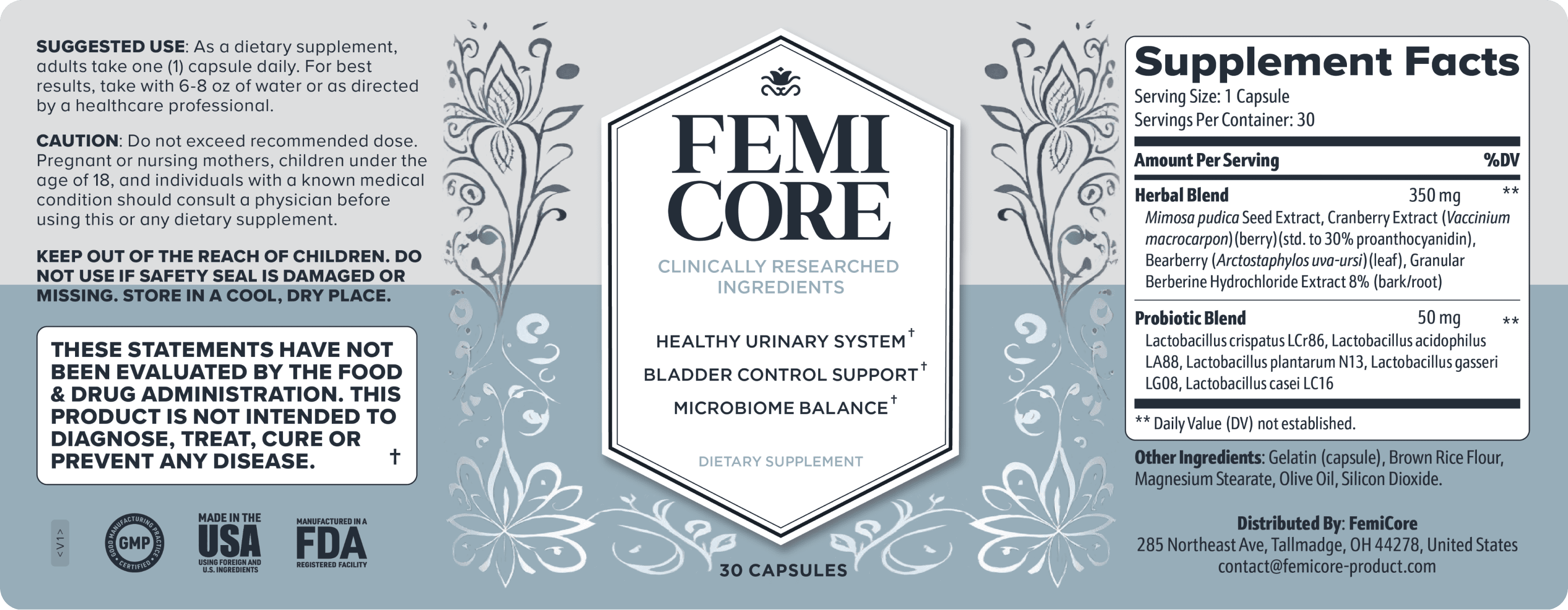
These probiotic strains work together to restore the protective bacterial ecosystem your urinary tract needs to defend itself naturally.
These plant extracts work alongside the probiotics to create an environment where beneficial bacteria can thrive and harmful bacteria cannot.
FemiCore doesn't force your body to respond a certain way like a drug. It provides your microbiome with the Lactobacillus strains and botanical support it needs to restore its natural protective function.
Rebuilding an ecosystem takes time. Here's what to expect:
The probiotic strains begin surviving transit through your stomach acid and arriving in your intestinal tract. Some begin colonizing immediately in your gut and vaginal tract. The botanicals (cranberry, bearberry, berberine) provide acute urinary tract support while the probiotics establish themselves. You probably won't feel dramatically different yet, but the microscopic restoration work is happening.
The Lactobacillus strains start producing their protective compounds—lactic acid, hydrogen peroxide, antimicrobial peptides. Your vaginal pH begins shifting toward the optimal 3.8-4.5 range. The cranberry PACs are preventing E. coli adhesion. The berberine is modulating bladder muscle response. You might notice your bladder feels slightly calmer. Nighttime bathroom trips might decrease by one. The changes are subtle but real.
This is when most women notice the difference becomes obvious. The protective Lactobacillus strains have established themselves enough to actually change your microbiome composition. Your vaginal pH is more stable. Your immune system isn't in constant alert mode fighting dysbiosis. Bladder urgency decreases noticeably. You can sit through meetings, movies, or car rides without constantly planning bathroom access.
Your urinary and vaginal microbiome isn't just balanced—it's resilient. When you encounter stress, dietary changes, sexual activity, or other disruptions, your protective Lactobacillus flora can maintain equilibrium instead of collapsing. If you've been dealing with recurring UTIs, this is when that pattern typically breaks. Not because FemiCore is "preventing" infection—but because your body's natural microbiome defenses are functioning again.
Why does microbiome restoration take 6-8 weeks? Because that's how long bacterial populations need to establish stable colonization, outcompete dysbiotic bacteria, and produce consistent protective effects. Anyone promising overnight bladder control or instant UTI prevention doesn't understand how microbiomes work. We're rebuilding an ecosystem, not masking symptoms with drugs.
"I had recurring UTIs every two months for almost a year. My doctor kept prescribing antibiotics which would work temporarily, but then I'd get another infection within weeks. I was exhausted from the cycle. I started FemiCore in September, and by October I realized I wasn't constantly thinking about where the nearest bathroom was anymore. It's been six months now and I haven't had a single urinary tract infection. I honestly didn't think long-term relief was possible for me."
"The bladder urgency was ruining my life. I couldn't go hiking. I couldn't sit through my daughter's school plays without getting up twice. I was always planning my entire day around bathroom locations. I tried Kegels, I tried cutting out caffeine, I tried everything my doctor suggested. After about a month on FemiCore, I went an entire afternoon without thinking about my bladder, and I actually cried. When you've been dealing with overactive bladder for years, getting your life back feels like a miracle."
"I was skeptical because I've tried regular probiotics before for feminine health. They helped my digestion a little but did nothing for my recurring bladder infections. FemiCore is completely different. Within three weeks, my digestion felt better AND I wasn't getting that uncomfortable burning sensation I used to get before every UTI. I'm on my fourth bottle now and I genuinely feel like my body is working with me instead of constantly fighting itself."
These experiences represent the consistent pattern we hear: gradual microbiome restoration over several weeks, with the most significant improvements in bladder control and UTI prevention happening around the 4-8 week mark.
The fundamental difference between FemiCore and everything else you've tried comes down to one thing: we're addressing the root cause (urinary microbiome imbalance), not just managing symptoms.
Antibiotics kill bacteria indiscriminately. Cranberry prevents bacterial adhesion. D-Mannose flushes bacteria out. Prescription medications like oxybutynin force your bladder muscle to relax chemically.
All of these approaches treat the manifestation of the problem. None of them restore the protective Lactobacillus ecosystem that prevents bladder issues and UTIs from happening in the first place.
FemiCore gives your urinary and vaginal microbiome what it needs to defend itself naturally—the same way a healthy, balanced microbiome is supposed to work.
That's not a quick fix. It's a restoration process. But it's the only approach that actually breaks the recurring infection cycle instead of just delaying the next episode.
Want to see the clinical research? FemiCore's formulation is based on published studies in the American Journal of Obstetrics and Gynecology, Journal of Ethnopharmacology, The Lancet Microbe, and other peer-reviewed journals. View all clinical references →
Take one capsule every morning with a glass of water. We recommend taking it with breakfast or your first meal of the day. Food helps buffer the probiotic strains as they transit through stomach acid, improving survival rates and colonization success.
For the first month, be consistent. Don't skip days. The Lactobacillus strains need regular introduction to establish stable colonization, especially initially when your microbiome is still imbalanced.
Most women continue taking FemiCore daily for 3-6 months to fully restore microbiome resilience and break recurring infection patterns. After that, some continue as maintenance, some reduce frequency to 3-4 times per week, and some stop entirely and only resume if symptoms return.
Your body will tell you what it needs based on how you feel and whether your bladder control and infection patterns improve.
Important: If you're currently taking antibiotics for a UTI: Wait until you finish the antibiotic course before starting FemiCore. Antibiotics will kill the probiotic strains before they can colonize your urinary tract. Once you complete antibiotics, that's the ideal time to start FemiCore—your protective Lactobacillus flora has been decimated and needs rebuilding to prevent the next infection.
We can show you the clinical research on Lactobacillus strains. We can explain the urinary microbiome mechanism. We can share testimonials from thousands of women.
But ultimately, the only thing that matters is whether FemiCore works for your bladder health.
That's why every bottle comes with a 60-day money-back guarantee.
Try it for two full months—long enough for the Lactobacillus strains to colonize and the microbiome restoration mechanism to work. If you don't notice meaningful improvement in bladder control, if your UTI pattern doesn't change, if you don't feel better overall—contact us and we'll refund every cent.
No forms. No hoops. No questions about why it didn't work for you.
We built FemiCore because we believed there had to be a better approach than the endless cycle of antibiotics and temporary relief. The research on urinary microbiome health said this should work. The mechanism made scientific sense. But the real test was whether women actually got their lives back.
The guarantee exists because we're confident in what we built. If it doesn't restore your bladder health, we don't deserve your money.
We're not going to tell you FemiCore will change your life overnight. We're not going to promise you'll never have another urinary issue or bladder concern.
What we will tell you is this:
After two years of research into urinary microbiome health, fourteen months of formulation work, and thousands of conversations with women dealing with recurring bladder problems and UTIs, we built something that addresses the actual mechanism instead of just managing symptoms.
FemiCore restores the protective Lactobacillus strains your urinary and vaginal microbiome needs to defend itself naturally. It's not a quick fix or symptom suppressor. It's a restoration process that takes 6-8 weeks to fully work because that's how long microbiome rebalancing requires.
But for women who commit to that timeline and take FemiCore consistently, the majority report meaningful improvement in bladder control, fewer UTIs, and the relief of not having to plan their entire life around bathroom access.
You have 60 days to decide if you're one of them.
If FemiCore helps restore your urinary microbiome balance and gives you back the freedom and comfort you've been missing—that's worth everything.
If it doesn't work after a full two-month trial? You get your money back, and you're no worse off than you are right now.
The only risk is staying exactly where you are—stuck in the recurring cycle of bladder issues, UTIs, and temporary relief that never lasts.
Why we offer 60 days instead of 30: Because microbiome restoration takes time. Most women start seeing changes in bladder control around week 3-4, but we want you to have enough time to experience the full effect—including breaking the recurring UTI cycle—before deciding. That's only fair, and it's based on the science of how long Lactobacillus colonization actually takes.